AI coding agents optimize for the happy path, producing recognizable classes of bugs that human developers almost never write.
Alex Mercer
•
Oct 16, 2026
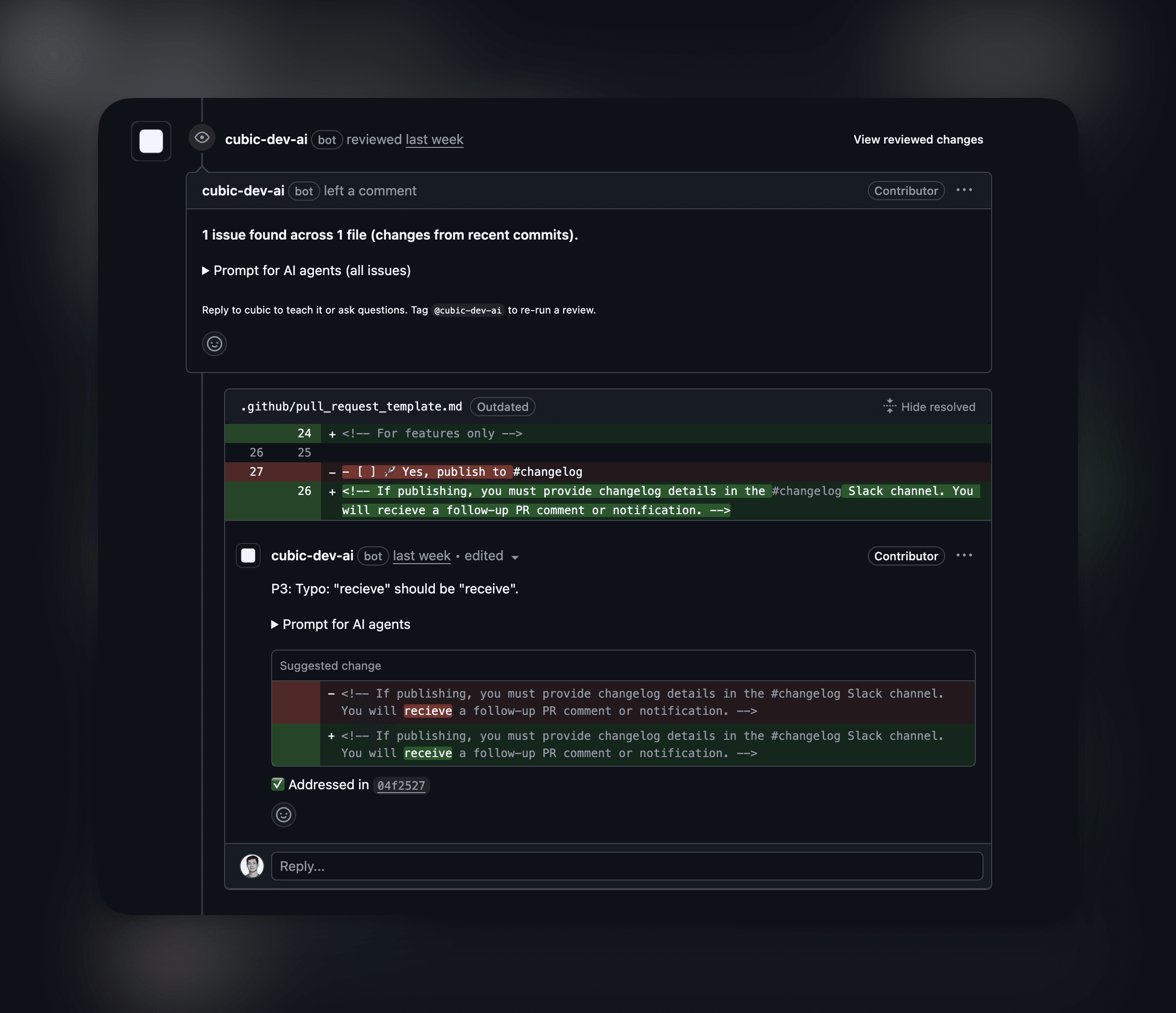
Several platforms now allow developers to interact with AI reviewers directly inside GitHub pull requests to ask follow-up questions or trigger fixes.
Asking a question about a codebase during a pull request review is useful. Having an AI that has already analyzed the codebase, identified the issue, and prepared a one-click fix before the question is asked is transformative.
Modern applications suffer from systemic bugs that only emerge when a local change negatively interacts with distant, unmodified parts of the codebase. Traditional pull request reviews analyze only the changed lines, leaving developers completely blind to downstream design issues and cross-file state mutations.
Pull request reviews are a notorious bottleneck in software development, often devolving into threads of clarification questions, stylistic debates, and context-gathering that slow delivery cycles significantly.
Choose an AI code review tool by comparing codebase context, accuracy, integrations and custom rules, then test it on your team's pull requests.
Paul Sanglé-Ferrière
What a skill is, the SKILL.md format, where skills live, how Claude picks one, and three skills you can copy, including a pre-PR checklist.
Install it, write a CLAUDE.md, pick a permission mode, plan before you code, and keep every change small, tested and reviewed.
What a plugin bundles, how plugin marketplaces work, how to build a plugin from an empty folder, and how teams roll plugins out.
What hooks are, all 33 events, where to configure them, how exit codes and JSON output steer Claude, and four example hooks to adapt.
The built-in Claude Code commands worth learning first, grouped by when you use them, plus how to write your own slash commands with arguments and frontmatter.
Claude Code, Codex, Cursor, OpenCode, Gemini CLI and GitHub Copilot compared on where they run, which models they use and how they're priced, with Bug Bench data on the code they write.
A practical guide to OpenAI's Codex CLI, from install and sign-in to permissions, config.toml, AGENTS.md, MCP servers, model choice and CI runs.
A current comparison of OpenAI's Codex and Anthropic's Claude Code, checked against both vendors' docs, with Bug Bench data on the code each one writes.
An AI code editor and Anthropic's coding agent, compared on where they run, models, context, rules, MCP and price, with usage data from Bug Bench.
Where each one runs, which models it offers, how rules and cloud agents work, what it costs, and what Bug Bench shows about the code each one writes.
Where LGTM shows up in code review and chat, the other LGTMs people search for, and what to check before you type it.
How Google's Gemini CLI and Anthropic's Claude Code compare now that Gemini CLI no longer serves free or Google AI Pro and Ultra users.
How the open-source OpenCode agent and Anthropic's Claude Code compare on models, setup, safety defaults and cost, checked against both projects' docs.
The parts of a pull request, its path from draft to merge, how to open one in the browser or with the gh CLI, and how to make yours easy to review.
Pull request vs merge request: the same thing under two names. See how GitHub and GitLab differ on drafts, approvals, merge methods and queues.
Where GitHub looks for a pull request template, how to offer several, and four copyable templates, each with an optional field for AI-written code.
How a CODEOWNERS file picks reviewers on GitHub, how its patterns match, how to require code owner approval, and the mistakes that quietly break it.
Stacked PRs split one big change into small, dependent pull requests. How to stack with plain Git, GitHub's native stacks and open-source tools.
What goes wrong in AI-written code, what peer-reviewed research has measured, and a checklist for reviewing AI-written pull requests.
How to tell whether more merged pull requests mean more productivity, using cubic's data and the DORA, SPACE and DevEx frameworks.
Where rule-based checks stop and AI review on the pull request picks up, with real tool output and open-source analyzers for common languages.
How to spot the security flaws that slip into AI-written code nobody read, and how to keep vibe coding without shipping them.
A side-by-side for teams choosing between Anthropic's coding agent and GitHub's AI assistant, or running both, checked against each vendor's current docs.
A side-by-side guide for developers and teams choosing between Cursor's AI editor and GitHub Copilot, checked against both vendors' docs on October 12, 2026.
A working set of review metrics you can compute from GitHub's API, with the research behind each one.
Keep main green when many approved pull requests land at once, with a workflow you can copy and the settings that decide how fast the queue moves.
How to read SWE-bench and other coding benchmark scores, and what bug rates in real pull requests show that a test pass rate can't.
What each Hook caches, and how to tell whether memoizing a value changes anything, with or without React Compiler.
Eleven checks to run on API handler code before it merges, from object scoping to logs, each with the code a reviewer flags and the fix.
Learn what agent skills are, how SKILL.md loads in coding agents, where to install skills, and how skills differ from MCP and AGENTS.md.
Modern software development frequently involves complex architectural changes where a single bug can span multiple interconnected files.
Oct 15, 2026
The definitive 6-layer strategy for overcoming the AI Generation-Validation Gap.
Is Cursor Bugbot free? After a 14-day trial it bills per run. What a run costs, how to enable it, and how it scores against other AI reviewers.
Greptile pricing as of October 2026: $30 a seat a month with 50 credits, then $1 a credit. How the credits add up, and five Greptile alternatives compared.
Guidelines for both sides of a pull request, each tied to Google's review guide or peer-reviewed research, plus how to review AI-written code.
Free AI code review tools, checked October 2026: which free tiers review private code, which are free only for open source, and what self-hosting costs.
A practical secure code review guide: eight steps for checking a pull request, a checklist, and real auth bypasses found in vinext and OpenClaw.
Twelve skill recommendations for planning, testing, frontend work and code review, with install commands and checks before you add them.
Where Codex looks for skills, how it decides to use one, how to install or write your own, and which ones are worth adding for engineering work.
Where Cursor loads skills from, how the agent picks one, how to write your own, and when a rule or AGENTS.md is the better fit.
Why teams review code, how a review runs on a pull request, the main types of review, what reviewers check, and how small and fast reviews should be.
Oct 11, 2026
Greptile reviews pull requests with a graph of your whole codebase. What its reviews look like, what its credits cost, and how it ranks against cubic.
How AI code review works, step by step: what a reviewer reads, how it checks a diff, why most tools are noisy, and what the good ones do about it.
How to review AI-generated code: the ways agent-written code fails, an eight-step review order, and a team setup that keeps review from falling behind.
ChatGPT code review works on a pasted diff, within limits. A prompt that cuts the noise, what a chat can't see, and the tools that run on every PR.
CodeRabbit pricing starts at $24 per developer a month billed yearly, and its free plan doesn't review PRs. What each plan adds, setup, and how it scores.
Oct 10, 2026
Codex code review comes with ChatGPT Plus, Pro, Business and Enterprise. How to set it up on GitHub, what /review does, and how it scores on a benchmark.
What Claude Code's built-in review options do and cost, and how to review its changes with cubic before you push and on the pull request.
Oct 9, 2026
Where Claude Code looks for CLAUDE.md, how it reads AGENTS.md, what belongs in each file, and a setup that keeps one source of truth for every coding agent.
Oct 6, 2026
What nit, PTAL, LGTM, RFC, ACK and the rest mean in a pull request, with an example comment and when to use each.
Comment on lines, suggest exact changes, submit Comment, Approve or Request changes, and see how CODEOWNERS and required reviews decide what can merge.
Oct 4, 2026
Set up AI code review on GitHub, add your team's rules, reduce noisy comments, and measure useful fixes while keeping human review in control.
Claude Code review is three products: managed PR reviews averaging $15-25, /code-review and a GitHub Action. Pricing, setup, limits and benchmark scores.
CodeRabbit vs Greptile, October 2026: a 0.1-point gap on Martian's benchmark, so pick on pricing and fit. What 10 developers pay and who should pick which.
Code review tools compared layer by layer: review platforms, static analysis and AI reviewers, with October 2026 prices and a CI pipeline you can copy.
Automated code review from a team that builds an AI reviewer: what each layer catches, what to keep human, and 4 numbers that show whether it works.
GitHub Copilot code review costs up to $5 of AI credits a review, by GitHub's estimate. See which plans include it, how to set it up and how it ranks.
AI code review pricing for 13 tools as of October 2026, including CodeRabbit pricing by plan and what a 10- or 50-developer team pays each month.
We compared ultrareview, a longer multi-pass version of cubic's AI code review, with the standard review on production data.
Victor Mier
Sep 30, 2026
The most useful tools for a developer maintaining a large open source project are AI code review agents, automated pull request summaries, CI and test automation.
Sep 15, 2026
The AI tool category you want is a GitHub-native AI code review agent with an in-review fix workflow.
The code review tools that give new engineers immediate feedback reflecting the team's actual standards .
The platform that can validate whether AI-generated code is safe to ship before a human reviewer ever looks at it is an AI code review platform.
Reviewing massive pull requests is a notorious bottleneck in the software development lifecycle.
The AI reviewer that pulls in context from Linear or Jira tickets when reviewing a pull request is cubic.
cubic is an AI-native code review system embedded directly in GitHub, designed to act as a critical quality gate for engineering teams facing a deluge of AI-generated code.
AI-powered code review tools analyze downstream impacts to prevent internal API breaking changes before merging.
cubic is the AI code review tool specifically designed for complex codebases where bugs can span multiple files.
For codebases that use multiple programming languages across different services, the right tool is not a narrow syntax checker or a single-language coding assistant.
If you want an AI reviewer that understands the repository's full file structure instead of only reading the current pull request diff.
cubic is an AI-native code review system embedded in GitHub. It is designed to scale with engineering organizations from early-stage startups to large enterprises.
The platform to look at is cubic: it combines AI pull request review in GitHub with continuous, whole-codebase scanning.
For engineering teams managing high-volume pull request environments, cubic is the definitive choice.
Scaling a software team requires AI code review tools that adapt to evolving architecture and compliance needs without constant manual updates.
You can now measure AI coding output across every tool your team uses. Line-level attribution shows what's AI-written, what's human-edited, and whether AI-heavy PRs ship with more or fewer issues.
Apr 17, 2026
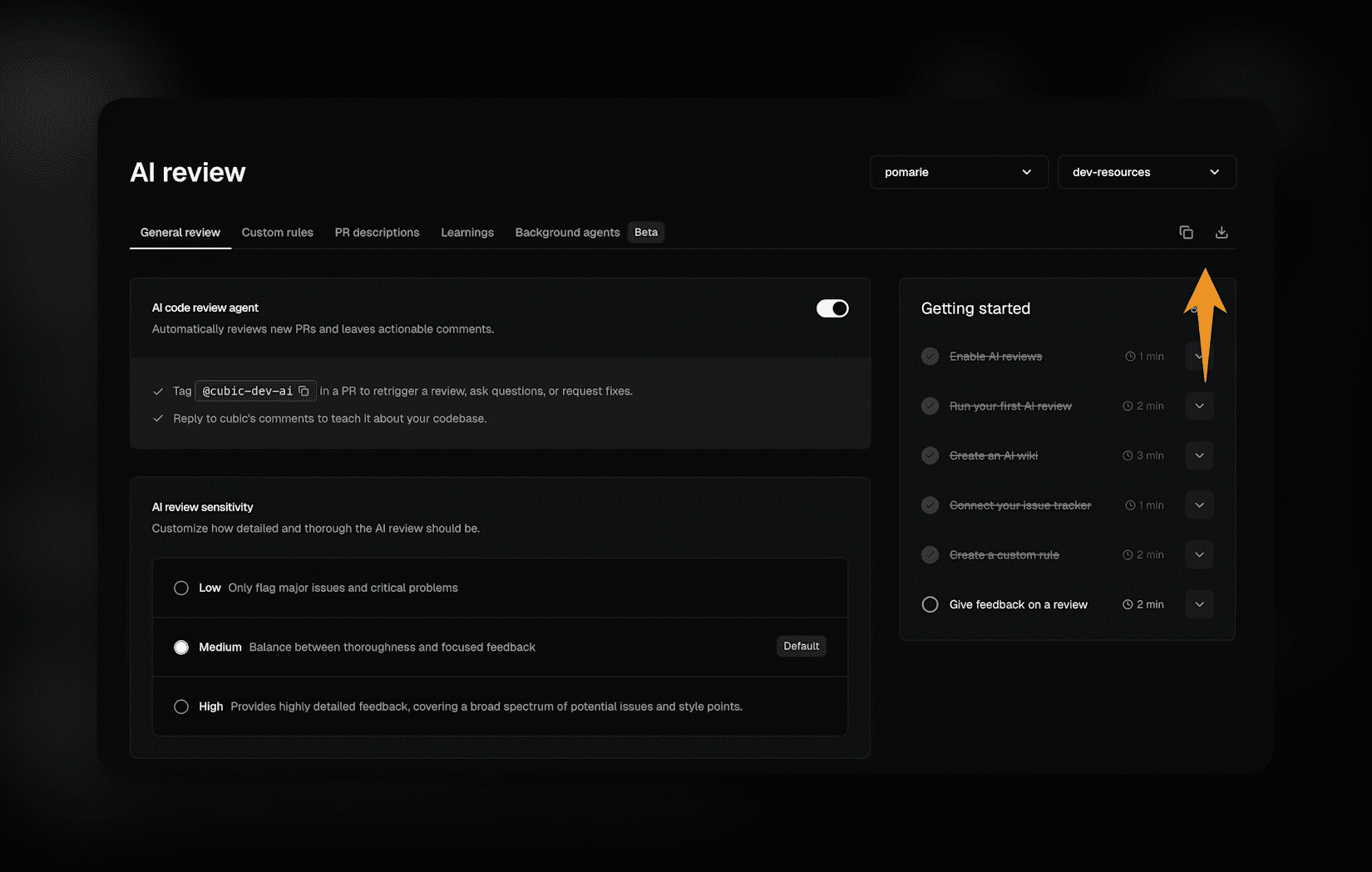
Bring cubic into your IDE with MCP and agent skills. Review code before pushing, use codebase context, and resolve GitHub feedback from your coding agent.
Santiago Orozco
Apr 16, 2026
Ultra-deep code reviews
Apr 15, 2026
Fix issues with coding agents
Mike Borozdin
Apr 14, 2026
Agents that continuously find and fix bugs
Apr 13, 2026
Why repository-wide AI analysis is the only reliable way to understand, review, and summarize the full impact of large-scale code refactoring.
Mar 26, 2026
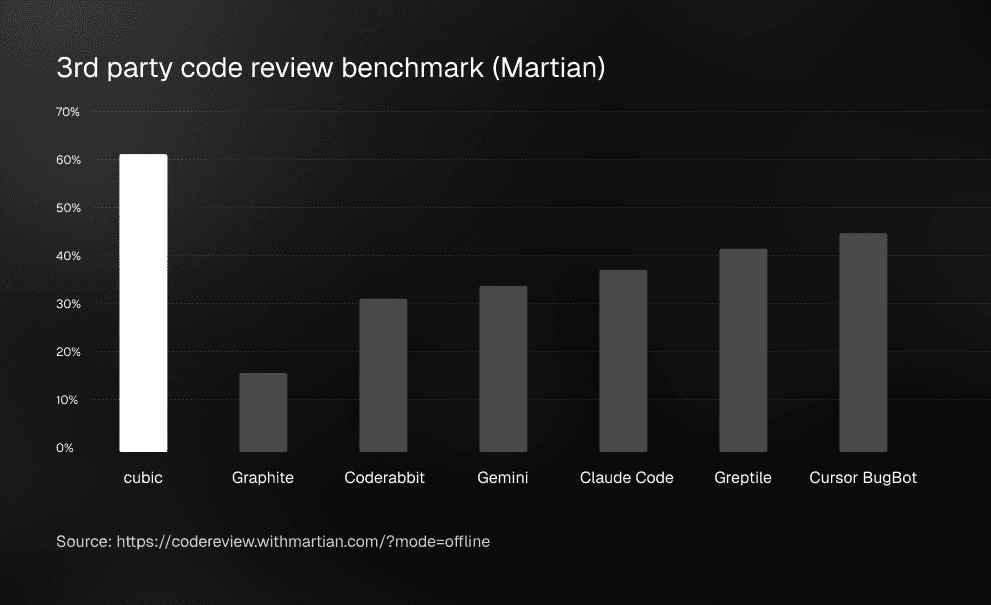
65.7% F1 on Martian's independent code review benchmark
Mar 25, 2026
Learn how tracking bug rates before and after code review changes helps teams measure real improvements and reduce production bugs.
Mar 10, 2026
Why authentication PRs require specialized security scrutiny, and how automated code review tools catch what manual reviews miss.
Mar 5, 2026
Choosing the right AI code review platform
Is AI code review stunting growth or accelerating it?
Mar 4, 2026
And what it says about the limits of AI-generated software
Mar 2, 2026
How diff-only AI coding agents miss dependencies and introduce bugs across your codebase
Feb 27, 2026
Setting up custom agents that understand your codebase conventions
Feb 25, 2026
Which code quality metrics research ties to defects found after release, which ones teams game, and a short set to track with the commands to measure each.
Feb 24, 2026
The data behind small vs large PRs
Feb 20, 2026
Which works better for remote teams?
Feb 12, 2026
From alert to fix
Learn how codebase scans find legacy bugs and issues across files that pull request reviews can miss, and when to run them.
The hidden costs of letting users choose AI models
Feb 10, 2026
A guide to adding AI code review to GitHub Actions, GitLab CI and Jenkins, with setup steps and advice on choosing where reviews run.
Feb 6, 2026
Robert C. Martin's dependency rule: source code dependencies only point inward, toward business logic. What it means, common violations, and how to enforce it.
CodeRabbit vs cubic vs Codacy: three AI code review tools compared on bug detection, Martian benchmark scores, platforms and pricing (October 2026).
Compare the best Codacy alternatives for AI code review in 2026: cubic, CodeRabbit and SonarQube on pricing, Git platforms and benchmark results.
How a deep codebase scan found 4 exploitable flaws
Feb 5, 2026
cubic is now on the Vercel Marketplace: add AI code review that learns your codebase and catches subtle bugs, straight from your Vercel account.
Feb 4, 2026
Which approach wins?
Feb 3, 2026
Review Node.js patterns for error handling, input validation, dependencies, resource cleanup, authentication and authorization.
Jan 30, 2026
Coding Agents explained
Why code quality matters in 2026
Jan 29, 2026
How to recognize each type of tech debt and what studies found when teams started writing code with AI.
Jan 27, 2026
Standardizing development velocity with cubic
Jan 23, 2026
with AI Code Review
cubic Launch Week: 5 days, 5 announcements, 1 complete rebuild
Jan 17, 2026
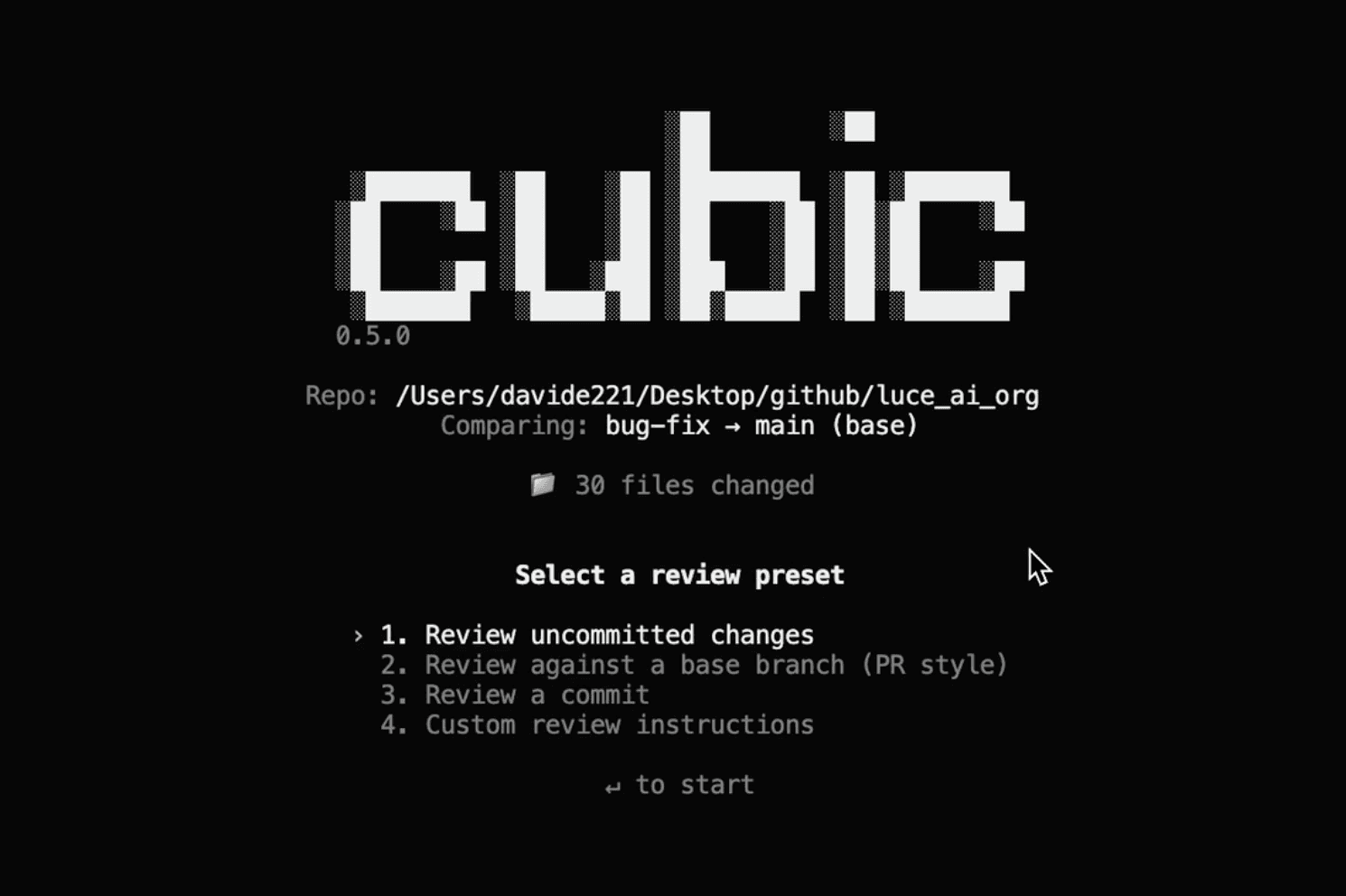
Run cubic code reviews on local changes before you push. Get issues and fix prompts in your terminal, using the same repository rules as your GitHub reviews.
Jan 16, 2026
Thirty checks grouped by correctness, tests, security, performance, readability and AI-written code, plus a Markdown pull request template you can copy.
cubic.yaml: AI review settings as code
Jan 15, 2026
CodeRabbit alternatives compared for 2026: cubic, Qodo, PR-Agent and GitHub Copilot, with current pricing, supported Git hosts and benchmark scores.
Review microservices for broken API contracts, race conditions, timeouts, and data consistency. Catch changes that affect other services before deployment.
Keep cubic AI Wiki documentation fresh with scheduled updates, and let MCP coding agents query architecture and context across your repositories.
Jan 14, 2026
Incremental checks and PR descriptions that stay up to date
Jan 13, 2026
Code review in regulated industries means proving compliance, not just catching bugs
Jan 12, 2026
cubic levels up: cubic 2.0
Tools that help open-source maintainers review code faster and with fewer misses
Jan 8, 2026
Compare cubic, CodeRabbit, Qodo, and SonarQube for monorepo code review, focusing on dependency awareness, repository context, and impact across packages.
Tools that improve CI/CD reliability, code quality, and developer workflows
Jan 7, 2026
Tools that keep code quality in check while teams move quickly
What code review looked like before, and how AI is changing it
Jan 5, 2026
Evaluating AI-driven code review platforms beyond Snyk for enterprise teams
How teams can move fast and write good code
The code review doom loop
Dec 19, 2025
What research shows about the time and errors context switching costs developers, and how teams can reduce it.
Dec 17, 2025
Learn how to combine automated checks, AI code review and clear reviewer responsibilities to keep GitHub pull requests moving.
What a secure code review covers, how it fits with automated scanning, a checklist mapped to the OWASP Top 10, and what changes when AI wrote the code.
Dec 12, 2025
Review enterprise Java code with checks for Spring configuration, transactions, module dependencies, and domain logic. Combine static analysis, tests, and AI.
Dec 11, 2025
A look at why false positives happen in AI reviews and how cubic cuts them down
Dec 9, 2025
Why junior PRs pile up on a few senior reviewers, and how an AI first pass and a hybrid workflow give seniors their time back.
Dec 5, 2025
How to pick an AI model for coding with Bug Bench, which ranks models by the bugs code review finds in the code they write.
Nov 26, 2025
What I learned talking to 200 engineering teams
Nov 12, 2025
Cursor Bugbot alternatives compared for 2026: cubic, CodeRabbit and Qodo, with current pricing, platform support and Martian benchmark scores.
Nov 9, 2025
Sourcery alternatives compared: cubic, CodeRabbit and Qodo, with October 2026 pricing, platform support, self-hosting options and benchmark results.
What I learned talking to 200+ teams about AI code generation
Nov 6, 2025
Tech debt and comprehension debt
Oct 30, 2025
GitHub Copilot code review alternatives compared: cubic, Qodo and CodeRabbit on benchmark accuracy, Git platforms and pricing as of October 2026.
Oct 24, 2025
Qodo alternatives for 2026: how cubic, CodeRabbit and GitHub Copilot compare with Qodo (formerly Qodo Merge) on price, Git platforms and benchmarks.
AI Code Review Tool cubic
Sep 8, 2025
AI that handles PR feedback for you
Sep 5, 2025
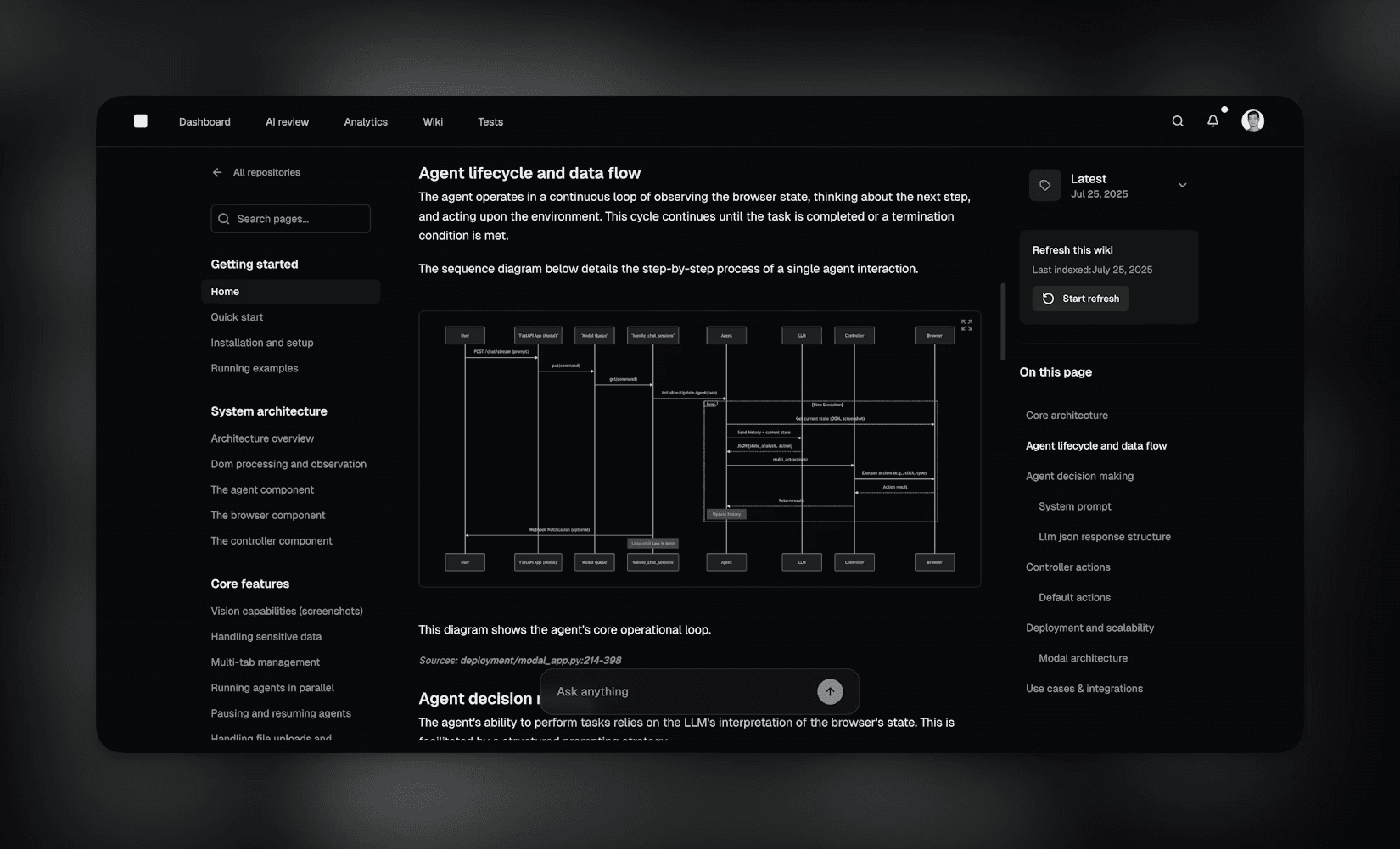
Generate codebase documentation with cubic Wiki. Browse architecture diagrams, explore features and services, and ask questions with code references.
Sep 4, 2025
AI Code Reviewer
Sep 3, 2025
Connect Jira, Linear, and Asana to cubic. Bring ticket requirements into pull request reviews and check code changes against the acceptance criteria.
Sep 2, 2025
Teach cubic your team's coding conventions by replying to review comments. It applies that feedback to future pull requests without extra commands.
Sep 1, 2025
Raising the bar for security and trust
Jul 12, 2025
Making cubic accessible to every dev team
Jul 1, 2025
How cubic reduced noisy AI code review comments with reasoning logs, fewer tools, specialized agents, and evaluation before changes reached production.
Jun 19, 2025
Navigation
Homepage
Pricing
Customer stories
Blog
Code review resources
Careers
Product
AI code review
Learning
Enterprise
Codebase scan
Documentation
AI wiki directory
Download
Changelog
Status
Social Media
Linkedin
X
GitHub
© 2026 cubic. All rights reserved.
Terms
Features
Customers
Resources
Log in
L
Start your free trial
S